Why Most Iron Supplements Don’t Work (And What Actually Gets Absorbed)
by Dr Duncan Rozario If you’ve been told to take iron but still […]
By Dr. Duncan Rozario, Chief Medical Officer, Sigma Life Sciences
If you’re constantly tired, struggling with brain fog, or feeling like you’re just not functioning at your best, you are not alone.
Many women are told:
But in many cases, something important is being missed:
Iron deficiency.
And not just anemia—but early iron deficiency, where symptoms are present long before hemoglobin drops.
Iron deficiency is the most common nutritional deficiency in the world.
In Canada, up to 1 in 3 women of reproductive age may be affected.
The reasons are clear:
And yet, it is frequently underdiagnosed.
Many women don’t realize that their symptoms are connected to iron levels.
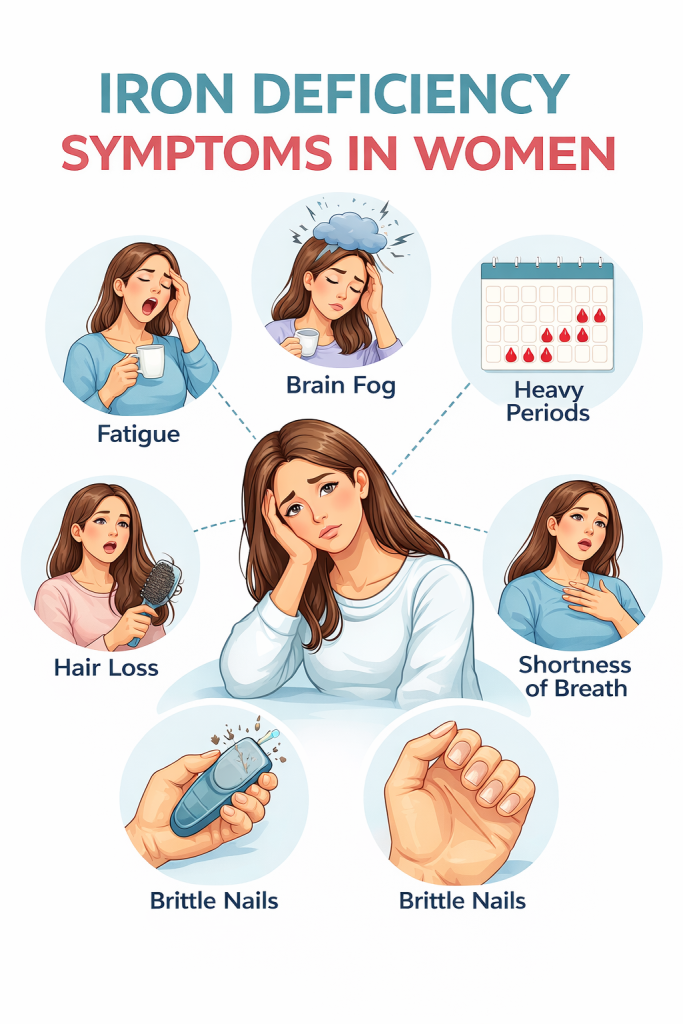
Here are the most common—and most overlooked—signs:
This is the hallmark symptom.
Not just “tired,” but:
Many patients I see have already tried conventional iron therapy without improvement—something I discuss in more detail in our article on why most iron supplements don’t work.
Iron plays a critical role in oxygen delivery to the brain.
Low iron can lead to:
This often occurs even before anemia develops—sometimes referred to as iron deficiency without anemia—which relates closely to how ferritin reflects your body’s true iron stores.
Heavy menstrual bleeding is both:
This creates a cycle:
Heavy periods → iron loss → fatigue → worsening overall health
This ongoing loss is one of the main reasons many women struggle to restore iron levels with traditional therapies.
Iron is essential for cell growth.
Low levels can lead to:
Even without anemia, low iron stores can affect:
These subtle symptoms are often dismissed—but are frequently linked to low iron stores.
This is where many women are missed.
You may be told:
“Your hemoglobin is normal”
But hemoglobin is a late marker.
By the time it drops, iron deficiency is already advanced.
The more sensitive test is:
👉 Ferritin (your body’s iron stores)
I have seen countless patients with:
Many women are correctly diagnosed—but still don’t improve.
Why?
Traditional iron (like ferrous sulfate):
Common issues include:
As a result:
👉 Many women stop taking iron altogether
Conventional oral iron is effective on paper but often fails in practice due to poor absorption and gastrointestinal side effects—issues explored further in our article on a watershed moment in treating iron deficiency.
If the problem is:
Then the solution must address both.
This is where newer approaches to iron therapy have emerged.
Sucrosomial® iron is designed to:
In practical terms, this means:
👉 Iron that patients can actually take consistently
You can learn more about this approach by exploring SiderAL® Sucrosomial Iron.
You should strongly consider checking your iron levels if you:
If this sounds familiar, the next step is simple:
Request:
If iron deficiency is present:
The best iron therapy is the one you:
👉 Can take consistently
👉 Can absorb effectively
👉 Can tolerate long-term
Iron deficiency is not rare.
It is not trivial.
And it should not be normalized.
Too many women are told to “push through” symptoms that are both identifiable and treatable.
If you’ve been struggling with fatigue, brain fog, or the effects of heavy periods, it may be time to look deeper.
Because feeling well should not be the exception—it should be the expectation.
If you’d like to better understand iron deficiency and why many therapies fall short, you can read our article on a watershed moment in treating iron deficiency.
If you suspect iron deficiency may be affecting you, speak with your physician or pharmacist—or visit SiderALIron.ca to learn more.
Yes. Many women have low ferritin (iron stores) while their hemoglobin remains normal.
This is called iron deficiency without anemia and can still cause symptoms such as fatigue, brain fog, and reduced concentration.
Symptoms can occur even at ferritin levels within the “normal” range.
Many patients begin to experience symptoms when ferritin drops below 30–50 µg/L, depending on the individual.
Traditional iron supplements (such as ferrous sulfate) can irritate the gastrointestinal tract, leading to:
This is one of the most common reasons patients stop treatment early.
This depends on severity and absorption.
Some patients improve within weeks, but full correction of iron stores may take several months.
The best iron supplement is one that is:
Newer formulations, such as Sucrosomial® iron, are designed to improve tolerability and absorption compared to traditional iron salts.
References
Camaschella C. Iron deficiency. Blood. 2019;133(1):30-39. PMID: 30401704
Gómez-Ramírez S, Brilli E, Tarantino G, Girelli D, Muñoz M. Sucrosomial® Iron: An Updated Review of Its Clinical Efficacy for the Treatment of Iron Deficiency. Pharmaceuticals (Basel). 2023 Jun 6;16(6):847. doi: 10.3390/ph16060847. PMID: 37375794; PMCID: PMC10305423.
If symptoms persist, it is worth asking your physician to check ferritin, not just hemoglobin.
Many cases of iron deficiency are missed when only hemoglobin is measured.
If you think you may have iron deficiency, speak with your healthcare professional about appropriate testing and treatment options.
Dr. Duncan Rozario is a practicing physician and serves as Chief Medical Officer for Sigma Life Sciences, the Canadian distributor of SiderAL® Sucrosomial® Iron.