Why Most Iron Supplements Don’t Work (And What Actually Gets Absorbed)
by Dr Duncan Rozario If you’ve been told to take iron but still […]
By Dr. Duncan Rozario, Chief Medical Officer, Sigma Life Sciences
If you’ve been diagnosed with iron deficiency or iron deficiency anemia, you will likely be offered one of two treatments:
At first glance, the choice seems straightforward.
But many patients quickly discover it’s not.
You may be asking:
These are critical questions—because the right choice can mean the difference between ongoing symptoms and true recovery.
The goal is simple:
👉 Restore iron stores (ferritin blood test)
👉 Improve symptoms (fatigue, brain fog, weakness)
👉 Do so in a way patients can actually sustain
Yet in practice, many patients remain symptomatic.
As discussed in our article on iron deficiency symptoms in women, patients often experience fatigue and brain fog long before anemia is even diagnosed.
👉 The problem is not just diagnosis
👉 The problem is treatment failure
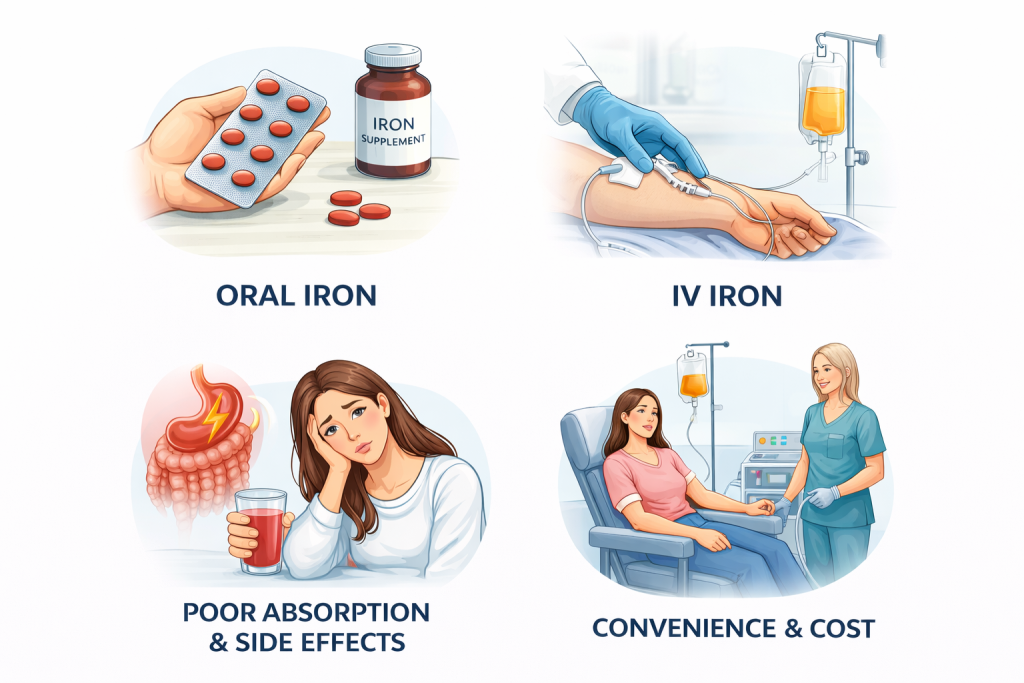
Oral iron is usually the starting point.
Common forms include:
In real-world patients, oral iron frequently does not deliver results.
Traditional iron:
Many patients take iron for months with little improvement.
This is the most common issue.
Patients report:
As a result:
👉 Many stop therapy early
This is a major reason why, as we explain in why most iron supplements don’t work, oral therapy often fails outside of clinical trials.
When oral iron fails, patients are often referred for IV iron.
IV iron involves:
It is significantly more expensive than oral therapy.
Patients must:
IV iron transforms iron deficiency into:
👉 A medical procedure
For many patients, this is more intensive than necessary.
| Factor | Oral Iron | IV Iron |
|---|---|---|
| Convenience | High | Low |
| Cost | Low | High |
| Speed | Slow | Fast |
| Tolerability | Often poor | Generally good |
| Access | Easy | Limited |
The traditional pathway has been:
Oral iron fails → move to IV iron
But this assumes all oral iron is the same.
It isn’t.
This is where modern therapy changes the conversation.
Newer formulations, such as Sucrosomial® iron, are designed to overcome the core limitations of traditional oral iron.
They:
This represents a shift from:
👉 “Can patients tolerate iron?”
to
👉 “Can we design iron patients can actually take?”
SiderAL® is a Sucrosomial® iron formulation designed for patients who:
In practical terms, it offers:
👉 An oral alternative to IV iron for many patients
👉 Improved tolerability
👉 Reliable absorption
👉 Ease of daily use
This aligns with what we outlined in a watershed moment in treating iron deficiency—a shift toward therapies that work in real patients, not just in theory.
IV iron remains essential in certain situations:
In these cases, IV therapy is appropriate and often necessary.
Many patients fall into a different category:
For these patients:
👉 Optimizing oral therapy is often the better next step
Across surgical, medical, and outpatient care, one pattern is clear:
👉 The issue is not access to iron
👉 The issue is effective, tolerable delivery
Patients don’t fail iron.
Iron therapy fails patients.
The decision is not simply:
Oral vs IV iron
It is:
What therapy will actually work—and be sustained—for this patient?
For many, the answer is no longer escalation to IV therapy.
It is:
👉 Better-designed oral therapy
👉 Improved tolerability
👉 Real-world adherence
If you are exploring your options:
Or visit SiderALIron.ca to learn more about advanced oral iron therapy.
IV iron works faster and bypasses absorption issues, but it is not always necessary.
Many patients can achieve excellent results with well-designed oral formulations.
Traditional iron supplements are limited by:
These factors lead to inconsistent results and poor adherence.
Yes. Advanced oral formulations such as Sucrosomial® iron are designed to improve absorption and tolerability, offering an effective alternative for many patients.
IV iron can improve iron levels within weeks, with symptom improvement often following shortly after.
In many cases, yes. Patients who cannot tolerate traditional iron may respond well to newer oral formulations designed to reduce gastrointestinal side effects.
Patients with:
may still require IV therapy.
References:
Gómez-Ramírez S, Brilli E, Tarantino G, Girelli D, Muñoz M. Sucrosomial® Iron: An Updated Review of Its Clinical Efficacy for the Treatment of Iron Deficiency. Pharmaceuticals (Basel). 2023 Jun 6;16(6):847. doi: 10.3390/ph16060847. PMID: 37375794; PMCID: PMC10305423.
Sholzberg, Michelle, Christopher Hillis, Mark Crowther, and Rita Selby. “Diagnosis and Management of Iron Deficiency in Females.” Canadian Medical Association Journal 197, no. 24 (2025): E680–E687. https://doi.org/10.1503/cmaj.240570.
If you think you may have iron deficiency, speak with your healthcare professional about appropriate testing and treatment options.
Dr. Duncan Rozario is a practicing physician and serves as Chief Medical Officer for Sigma Life Sciences, the Canadian distributor of SiderAL® Sucrosomial® Iron.